
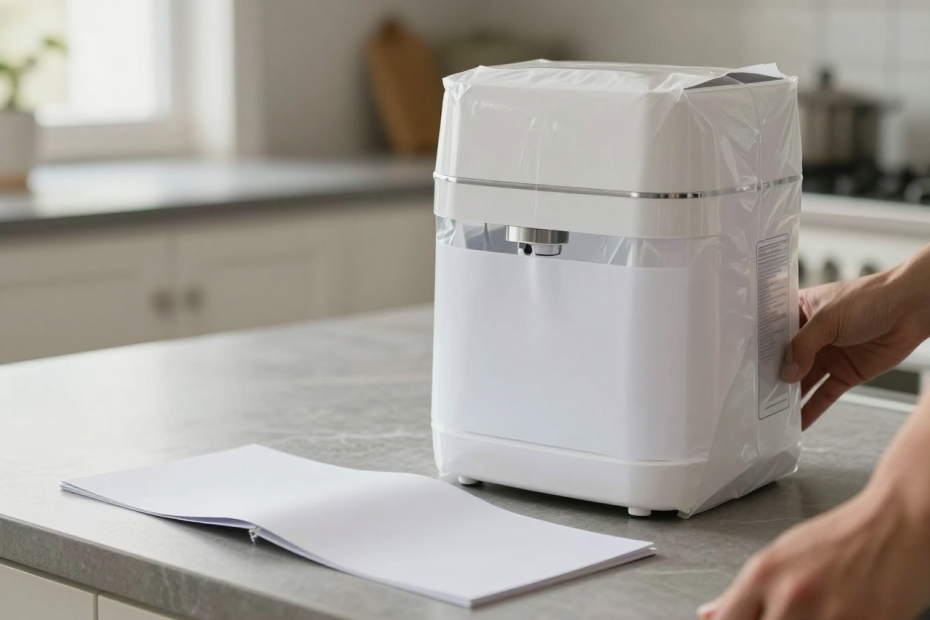
The first week of ownership is the only stretch of time when a customer is guaranteed to be paying attention to your product, and it is almost always the week in which a brand says nothing useful. The questions people actually have in those seven days are narrow, practical and predictable, which makes them straightforward to answer in advance.
We have written before about post-purchase engagement in general. This piece is narrower: what a customer wants on each of those seven days, what to put in front of them, and what to keep out of the way.
The questions are not the ones marketing expects
A customer in their first week is not thinking about your brand values. They are holding an object and working something out.
Across the projects we have run, the questions cluster into four groups, and they arrive in roughly the same order every time.
Is this the right one, and is it all here? Correct variant, correct size, nothing missing from the box, and for higher value goods, is it genuine.
How does this go together and how do I start? Setup, assembly, the first pour, the first charge, the first wash.
Is what I am seeing normal? The noise it makes, the smell, the settling, the first result not looking like the photograph.
What do I need to keep? Warranty, registration, the serial number, proof of purchase, the part number for the thing that will eventually wear out.
Not one of those is a marketing question. All of them are answerable in a paragraph.
Day by day
This is the practical version. Adjust it to your category, but keep the shape.
| When | What they are doing | Put in front of them | Leave out |
|---|---|---|---|
| Day 0 | Opening it | Contents check, the right setup guide for this exact variant, genuine confirmation | Brand story, newsletter sign up |
| Days 1 to 2 | First use | The three things people get wrong, and what normal looks like | Cross sell, review request |
| Days 3 to 5 | Settling in, or giving up | The second thing it does that nobody reads the manual to find | Anything that needs an account |
| Days 6 to 7 | Deciding to keep it | Warranty and registration, care and cleaning, where to get the consumable | Discount off the next order |
Day 3 is the one to design for. It is the point at which a product either becomes part of somebody’s routine or goes in a drawer, and it is the day almost nobody plans any content for because there is no transaction attached to it.
Useful content and marketing content are not the same thing
A quick test that settles most arguments internally.
Whose question does this answer? If it answers a question the customer actually asked themselves this morning, it is useful. If it answers a question the brand wishes they had asked, it is marketing. Both have their place. Only one of them earns a tap in week one.
Is it worth the tap on its own? If the value arrives only after an email address, an account or an app download, you have built a lead capture form and called it onboarding.
Is it specific to this item? “How to care for our products” is a page. “This one, in this colourway, washes at thirty and does not go in a dryer” is an answer. The second one is worth reading and the first one is not, and the difference costs nothing once the item is identifiable.
The things to leave out are just as important, because each one costs you the goodwill you have just earned. A review request before you have helped with anything asks the customer for a favour first. A discount code for the next purchase tells somebody who just paid full price that they paid too much. An account wall in front of a wash instruction is simply rude.
Why this is hard without something on the product
Most SMEs cannot run any of this by email, for a structural reason rather than a lack of effort.
If you sell through a shop, a distributor or a marketplace, you do not know who bought your product. The retailer knows. You have a sales figure and an assumption, and you cannot start a conversation with somebody whose name you have never been given.
That is why we put a tag into the product or its packaging. The customer taps it with a phone and gets a page that belongs to that individual item, with no app and no sign up. It works whoever sold it, and it works for the person who was given it as a present, which email never does.
Two properties matter more than they sound.
It is the right page. Because the page is bound to that item, it knows the variant, the batch and the date of manufacture. Nobody has to identify their own product from a grid of thumbnails, which is where most support enquiries actually begin.
It can change. The setup guide you write this month is not the one you will want in six months, once you know what people get wrong. A printed insert is fixed at the moment of printing. The page behind a tag is not.
What this looks like in practice
The Atom Brewing pump clip is the cleanest version of the principle. Atom Brewing Co is a brewery in Hull, and in April 2024 we put a tag into the pump clip on the bar. Tap it and you find out what is in the glass, who brewed it and where the beer is being poured next. Right moment, five seconds, no app, no form, and the brewery can change what appears whenever it likes.
The same logic applies to a kettle, a coat or a power tool. The moment is different. The rule is not: be useful at the moment they are already looking.
Measure three things, not twelve
Taps in the first seven days, as a share of units sold. That is your reach into the window, and it is usually the number that surprises people.
Repeat taps by the same item after day seven. That tells you whether what you put there was worth coming back to, which is the only real test of usefulness.
Support contacts per hundred units for the questions you answered. If the setup page is doing its job, the calls about that specific step should fall. That is the number to take to whoever signs off the budget, because it is the one with a cost attached.
Where to start
Do not build a programme. Build one page.
Ask whoever answers your phone or your inbox for the five questions they are asked most in the first week. Write a plain answer to each. Put those five answers behind whatever is on the product. Review them in a month against what people are still ringing up about.
That is a fortnight of work and it will outperform any campaign aimed at the same week, because it is the only thing in the week that was written for the person holding the product.
Veribli puts tags into products and packaging so a brand can be useful at the moment its customer is actually paying attention, whoever sold the item. If you want to talk through what the first week looks like for your product, call us on 01482 455 855.