
Ask ten marketers to define customer engagement and you will get ten answers, most of them involving social media. Here is a simpler way to look at it.
Customer engagement is the sum of every interaction a person has with your brand. Not just the ones you paid for.
Which raises an awkward question. Almost every pound in a marketing budget is spent on the period before someone buys. Advertising, social, search, promotions, packaging design, sampling. All of it aimed at the moment of purchase.
And then the customer buys. And the brand goes quiet.
The moment you go quiet is the moment they care most
Think about when a customer is most interested in your product.
It is not when they are scrolling past an advert. It is when they are holding the thing. When they have just unwrapped it, or are trying to work out how to use it, or have used it and liked it, or have used it and cannot get it to work.
That window, the first few days of ownership, is when your customer is paying more attention to your product than they ever will again. It is also, for most brands, the exact moment the relationship goes dark.
We spend fortunes on attention and then walk away from the only moment we have it for free.
Why it happens
It is not laziness. It is structural.
If you sell through retail, wholesale, a distributor or a marketplace, you never find out who bought your product. The shop knows. The marketplace knows. You do not. You have a sales figure and a guess.
That is the actual problem behind most customer engagement conversations. Not tone of voice, not posting frequency. You are trying to build a relationship with somebody whose name you do not know.
Email capture and loyalty schemes are the usual workaround, and they work, sort of. They ask the customer to do the brand a favour: fill in this form, download this app, join this scheme, and in return we will send you things. Response rates tell you how that bargain is received.
The product is already in their hands
The way round it is less obvious than it sounds, because it has been sitting in plain view.
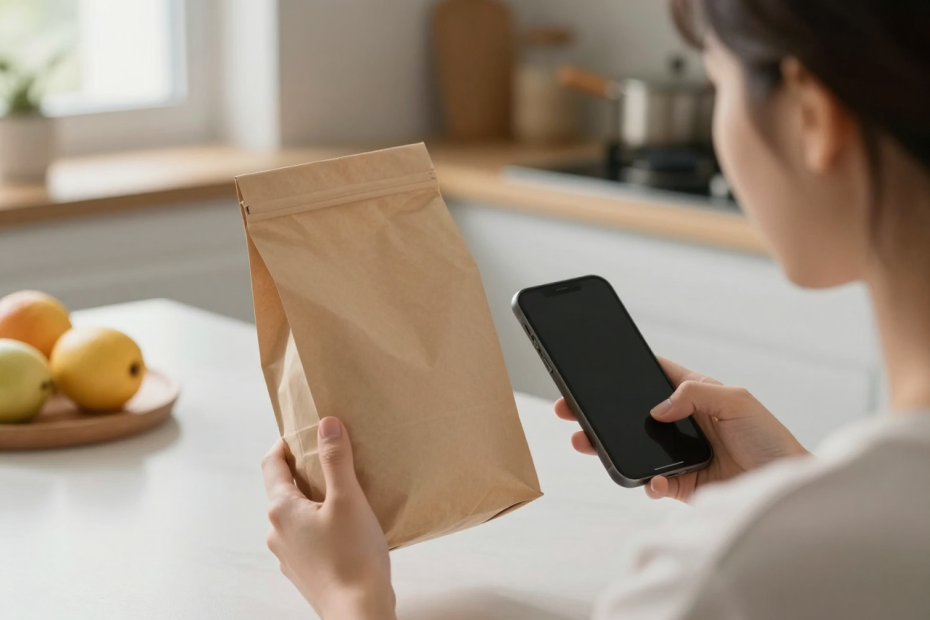
The customer is holding your product. Every modern smartphone can read a tag embedded in that product or its packaging without an app, without a download, and without asking anyone to sign up for anything. A tap.
That turns the product itself into the channel. Not a campaign that runs for six weeks. The thing they own, for as long as they own it.
And because the tag identifies that individual item rather than the product line, what appears can change. On the shelf it can be one thing. At home, the day after purchase, something else. Two years later, when it needs a part or a refill or a repair, something else again.
What that actually looks like
The useful version of this is not a brand video.
A jar of honey that knows it has been refilled eleven times, tells the customer the carbon they have saved by doing it, and credits them twenty pence for the next one.
A beer pump clip on the bar that tells you what you are drinking, who brewed it, and where the next one is being poured. We built exactly that with Atom Brewing Co, a brewery in Hull, and it works because the interaction happens at the point of genuine interest: pint in hand, curious, five seconds to spare.
A bike that can be marked as stolen by its owner, so that anyone who taps it before buying it second hand sees that it is stolen and is asked to call 101.
None of those are adverts. They are all useful. That is the whole point, and it is the bit most engagement strategies miss: people do not engage with brands, they engage with things that are useful to them.
What you get back
Three things, in order of how much they matter.
You find out who your customers are. Not a segment. The actual people who own your product, including everyone who bought it through a retailer you have no relationship with.
You get a reason to talk to them again. The refill, the spare part, the care instruction, the next product in the range. All of it triggered by the product they already own rather than by a campaign calendar.
Some of them become advocates. A customer who feels they have a relationship with a product tells other people about it. That has always been true. What is new is being able to see it happen, and knowing who to thank.
Where to start
Not with technology. With one question.
What would genuinely be useful to somebody in the first week of owning this product?
If you can answer that, you have a customer engagement strategy. If you cannot, no amount of posting will fix it.
Once you have the answer, the mechanism is straightforward. Veribli puts a tag in the product or its packaging, and gives you the platform to control exactly what a customer sees when they tap it, changing it whenever you like, without going back to a developer.
Our team has been working on this longer than most. The technology behind Veribli grew out of a system that tracked over 900 million refillable containers through a circular supply chain. We understand what happens to physical things after they leave the factory, because we have been following them for nearly thirty years.
If you want to talk about what your product could say to the person holding it, call us on 01482 455 855.