
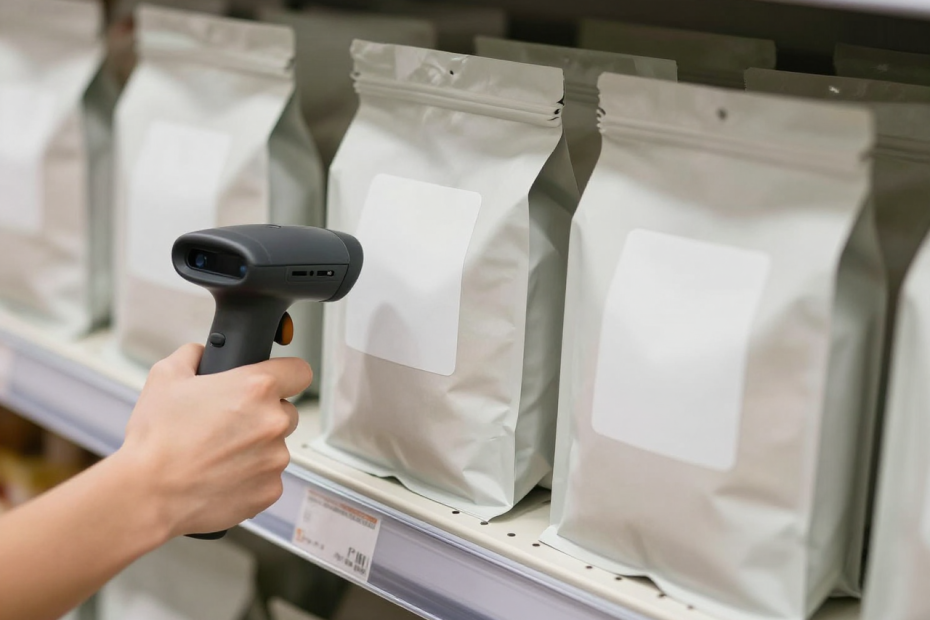
GS1 Digital Link is a standard that turns a product’s identifier into a web address, so a single code on a product can lead to different information depending on who scanned it and why. It matters for Digital Product Passports because it answers the carrier question without inventing a new numbering system: the identifier already printed on your packaging becomes the identifier the passport uses.
The surprising part is that one code can have many destinations, and that those destinations can be changed long after the packaging was printed. That is the bit worth explaining properly.
Start with the barcode already on your product
Nearly every retail product carries a GTIN, the Global Trade Item Number, printed as the familiar striped barcode. That barcode does one job and does it well: it tells a till which product this is, so it can be priced.
What it cannot do is anything else. It carries a number and nothing more. It has no way of saying which batch this came from, which individual item this is, where the care instructions live, or what the product is made of. Point a phone camera at it and you get thirteen digits with no idea what to do with them.
For forty years that was fine. It stopped being fine when regulation started asking products to carry a structured record about themselves.
What the standard actually does
GS1 Digital Link expresses that same identifier as a web address.
Instead of a bare number, the code carries a URL with the identifiers built into its structure:
“ https://id.example.com/01/05012345678900/21/00042 “
Read it left to right. The 01 is the GS1 application identifier for a GTIN, so 05012345678900 is the product. The 21 is the application identifier for a serial number, so 00042 is one specific item of that product. Swap in 10 and you are naming a batch instead.
Two things follow immediately. A browser can open it, because it is an ordinary URL. And any system that understands GS1 can still parse it, because the identifiers are in there in their standard form. Nothing had to be renumbered, and nothing had to be looked up in a private database first.
One code, many destinations
This is the part people find surprising, so it is worth being precise about it.
The URL does not point at a page. It points at a resolver: a service whose only job is to decide what a given scan should be answered with, then send the scanner there.
The resolver looks at what it can tell about the request and picks a destination. A request can also ask for a specific kind of information, using a link type:
| Who is scanning | What they ask for | What they get |
|---|---|---|
| A consumer with a phone | Nothing in particular | The product information page |
| A recycler | Recycling instructions | Disassembly and material data |
| A repairer | Service information | Manuals, parts, torque figures |
| A market surveillance authority | Conformity documentation | Certificates, test evidence, change history |
| A supply chain system | Event data | Where this item has been and when |
Same printed code. Different answers.
Two consequences fall out of that, and both are larger than they look.
The first is that the answer can change after printing. A label produced in 2024 can be pointed at a recall notice tomorrow, or at a revised care instruction next year, without touching a single physical item. The code is fixed. What sits behind it is not.
The second is that you stop needing a code per audience. Brands that started this before the standard existed ended up with a consumer QR code, a separate service QR code and a printed compliance panel, all saying different things and all going stale at different rates. One resolver replaces the lot.
Why it is becoming the default passport carrier
A Digital Product Passport has to be reachable from the product itself, machine readable, persistent, and different depending on who is asking. Those are not four separate problems if you use GS1 Digital Link, because the standard was built around the first three and the resolver handles the fourth.
There is also a political reason. The identifier already exists, it is globally unique, it is administered by a neutral body rather than a vendor, and retailers already use it. Any competing scheme has to explain why a manufacturer should number its products twice.
Persistence is the obligation people underestimate. A passport is expected to outlive the sale, and sometimes the product. Somebody has to keep the resolver answering for years, which makes the domain in that URL matter more than any other technical decision here. Choose one you will still control in a decade.
The retail barcode is changing anyway
GS1 member organisations have been working for several years towards two dimensional codes at the point of sale: a QR code carrying a Digital Link URL that a till can scan for pricing and a shopper can scan for information. The migration is usually referred to by a 2027 target date, and like every date in this field it needs checking against the current official position before you plan around it.
The direction is not in doubt even if the date moves. If your packaging is due a redesign, have this conversation with your artwork people now: the cheapest time to change a code is when the artwork is already open.
Model, batch or item
GS1 Digital Link will happily carry a GTIN on its own. That gives every unit of that product the same answer, which is enough for compliance in some categories and enough for nothing else.
Add the serial number and the code identifies one physical thing. That is the only level at which a refill count, an ownership record, a repair history or a resale provenance trail can exist, because all of those are facts about an individual item rather than about a product line.
We have built both. A honey jar that counts its own refills and credits twenty pence each time only works because the jar is serialised. A whisky cask with fill cycles, location and movement history is the same idea over a longer timeline.
What it does not do
It is not authentication. A printed Digital Link can be photographed and reprinted like any other printed code, and every copy resolves identically. It tells you what an item claims to be, never that the claim is true. If proof is the job, the identifier has to sit in something harder to copy than ink.
It is also not the passport. It is the doorway to it. The regulation cares far more about the completeness and accuracy of the data behind the code than about which carrier you chose.
Where to start
Three questions, in this order.
Do you control your own GTIN allocation, or does a retailer allocate on your behalf? If it is the retailer, you do not own the front door to your own passport.
Can your production line apply a unique serial per item, and at what cost per unit? That answer decides whether item level is available to you at all.
Who runs the resolver, and who will still be running it in ten years? Put that in writing before anything is printed.
Veribli builds product passports on top of tagging technology that has tracked physical items through circular supply chains for nearly thirty years, and we can help you work out what your codes should carry before your artwork is committed. Call us on 01482 455 855.